Memorial Duels and Constitutional Interpretation

We all have our favorite memorials. Even memorials that are not our favorites include inspirational quotes and sayings that we can use to bash folks we disagree with. Donald Kettl aims some Jefferson Memorial engravings at Justice Amy Cony Barrett and the late Justice Scalia. but his swing is way off the mark. https://www.marketwatch.com/story/thomas-jefferson-has-a-clear-message-for-the-supreme-court-about-the-constitution-and-originalism-11603988774 Even though I believe that text requires context, and believe that Congress does organize itself in committees and does include legislative reports, I don’t think the arguments of textualists and originalists should be mischaracterized. Therefore, a blog post is warranted. Mr. Kettl, I see your Jefferson engravings and raise you dolphins and a water crane.
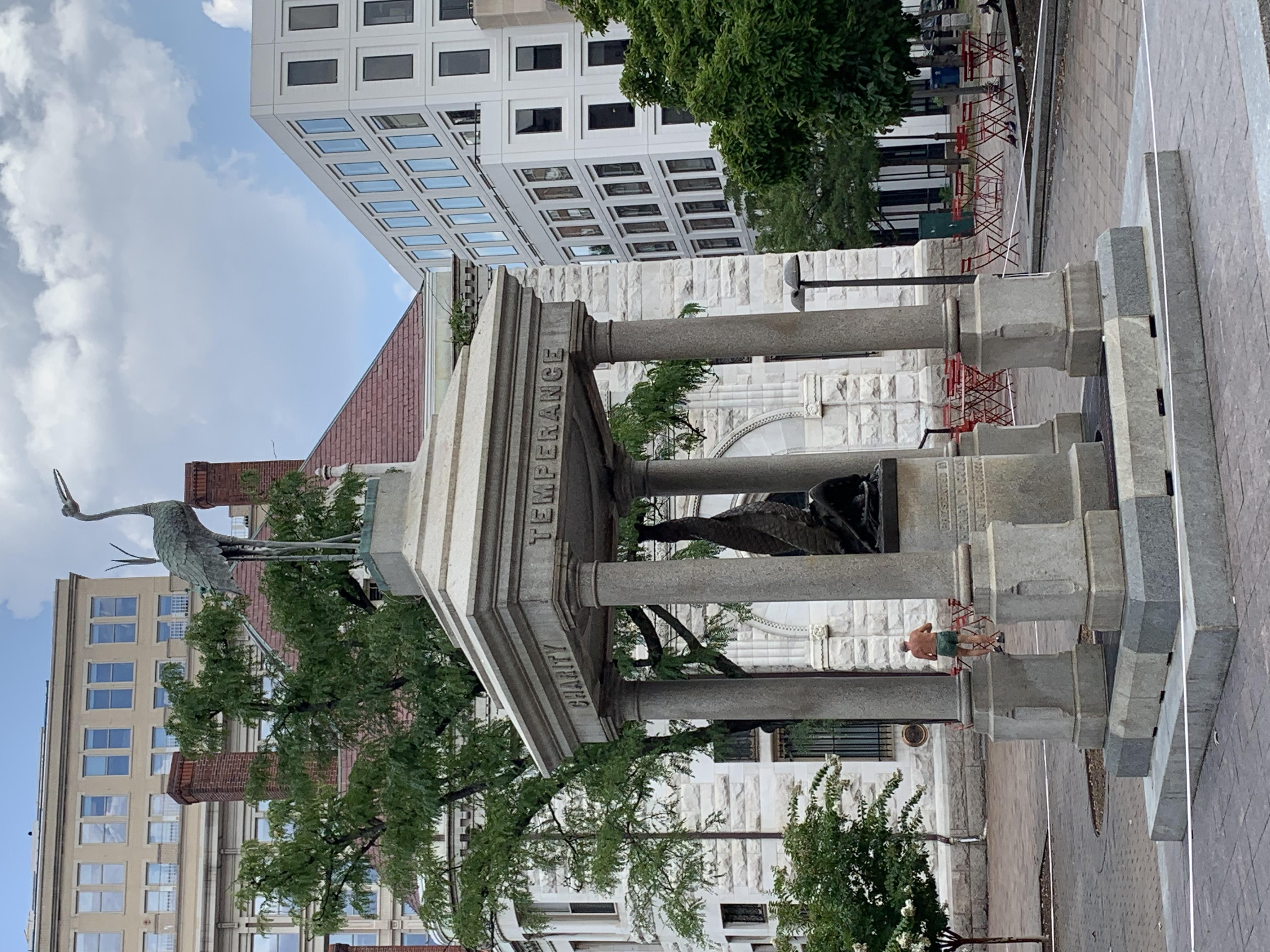
Temperance Fountain, 7th and Indiana, NW

Disposing of Donald Kettl’s Mischaracterization of Originalism

Before I go on my favorite memorials tangent, I should say Kettl’s topic is Constitutional interpretation. Kettl criticizes originalists like Scalia and his former clerk, the recently confirmed justice Barrett. As characterized by Kettl, the originalists have too much reverence for the Founding Fathers, and as a result prevent Constitutional change. This locks the country in outmoded laws and ways of life. If Kettl is correct, the originalists would have us trapped in the Constitution as written in 1787 by misogynist racists. Except Kettl is not correct.

I was raised in the city in which the Constitution was drafted, and this was how I was trained to address Donald Kettl’s argument.

Yo, Donald Kettl, read Article V. Or, should I say read the original Article V?

That little twist emphasizing the term ‘original’ is pure Philadelphia. Oh, wait, no – I am wrong. That twist is a common human exclamation. It was snarky and inappropriate. Like Article V itself, consider my impolite expression changed to “Please see Article V for methods to amend the Constitution.” In this case, the original writer (me) was not trapped. Often, the best way to change meaning is to change words. Here is an excerpt of Article V of the Constitution.

The Congress, whenever two thirds of both Houses shall deem it necessary, shall propose Amendments to this Constitution, or, on the Application of the Legislatures of two thirds of the several States, shall call a Convention for proposing Amendments, which, in either Case, shall be valid to all Intents and Purposes, as Part of this Constitution, when ratified by the Legislatures of three fourths of the several States, or by Conventions in three fourths thereof, as the one or the other Mode of Ratification may be proposed by the Congress;

An originalist who reads Article V of the Constitution recognizes that the Constitution can change with the times, or even ahead of the times. An originalist does not believe that our Constitutional provisions are trapped in 1787. New sections can be added, old sections can be removed, and the entire document can be replaced. There can even be a new Convention. We are not trapped by the scribblings of long dead misogynist racists after all. Article V provides for two different methods to change the Constitution, neither of which refers to a majority vote among the justices of the Supreme Court.

I refer the historically curious to Hamilton’s Federalist #85 for confirmation that the Founders knew their Constitution was imperfect and included provisions for amendment. I challenge Donald Kettl et. al. to find an example of an originalist rejecting Article V, or refusing to apply the subsequent 27 amendments on the grounds that they were not part of the original document in 1787.

** Claiming that existing words are dead is not the same as claiming existing words can’t be changed.

Jefferson Memorial Tangent: Kettl’s Chosen Quotes are Good Quotes

In making his erroneous critique, Kettle invokes the Jefferson Memorial in ways that should be amplified. Jefferson and the Founding Fathers believed in the power of the human mind to reason, to direct one’s own life, to progress, and to change. Those sentiments are engraved in stone overlooking the tidal basin in Washington DC, which I encourage everyone to visit, especially during the annual Cherry Blossom Festival. Kettle should be rewarded for praising Jefferson in the current intolerant climate. It is all too likely that the accusation “He quoted Jefferson!” will be enough to brand Kettl a racist. Here are the two Jefferson quotes he chose.

“I have sworn upon the altar of God eternal hostility against every form of tyranny over the mind of man.”

“I am not an advocate for frequent changes in laws and constitutions, but laws and institutions must go hand in hand with the progress of the human mind.”

Jefferson and his contemporaries believed in changing the Constitution. In addition to Article V discussed above, more than one state made ratification of the Constitution conditional upon it being amended to include a Bill of Rights, the first 10 amendments.

Nor was the founding generation content to defer to evolving interpretations of the Supreme Court justices. For example, the 11th amendment revised the text of the Constitution to invalidate the Supreme Court’s interpretation in the case Chisholm v Georgia. Later generations followed suit. The 14th amendment’s citizenship clause invalidated justice Taney’s reasoning in the Dred Scott case. In both examples, Chisholm and Dred Scott, Congress and the states used Article V to correct what they considered invalid Constitutional interpretations by the Supreme Court.

Court Packing? What Happened to Article V?

Frustrated with Supreme Court interpretations in high profile cases, some Progressives intend to ‘pack’ the Supreme Court if they attain power. The term packing refers to expanding the size of the Supreme Court so that the current president and Senate can add a sufficient number of justices to change selected Court decisions.

Packing the Supreme Court is Constitutional. It may or may not be wise, but the size of the court is set by statute and is subject to change through standard legislative procedure.

Packing the court is not a resilient way to change Constitutional interpretation. Since 2004, the United States has had (a) Republican President and Republican both chambers of Congress, (b) Republican President and Democratic Congress, (c) Democratic President and Democratic Congress, and (d) Democratic President and Republican Congress. If one party packs the court through statute when it controls the presidency and Congress, the other party can simply re-pack the Court through statute when it takes power. By 2035, we could have 33 seats on the Supreme Court.

Using Article V to change Constitutional interpretation is more difficult but more resilient. The Constitutional text is established by a super-majority (more than 50%) and takes a super-majority to amend.

Twenty-seven times Congress has passed Constitutional amendments by supermajority, which have been ratified by a super-majority of states. In some cases, such as Chisholm v Georgia, the amendments have been directed at specific Supreme Court interpretations that a super-majority of Congress and the states disagreed with.

Partisans have their Supreme Court rallying cries. Throughout US history, Constitutional interpretation affected politics. In the early days of the Republic, partisans differed on the Constitutionality of a national bank, the authority of Congress to legislate slavery in territories, and even Congress’s power to raise taxes on imports when revenues already exceeded expenses.

Current Politics and the Court

Some of the current partisan rallying cries focus on Supreme Court decisions related to abortions, guns, and campaign finances. The problem with textual originalists, some believe, is that they will focus on the Constitution as written. But that is also their virtue. Because Kettl is wrong and neither Scalia nor Barrett would look to 1787 to interpret the 25th amendment, which was proposed and ratified during the 1960s, the originalists can be directed to change their interpretation by changing the text. Use article V.

A common objection I get when suggesting Article V is interest group politics. The late Justice Stevens, who dissented in the Supreme Court’s Heller case recognizing an individual right to own guns, wanted a Constitutional amendment to address the issue – use article V. When Stevens explained that an amendment is simple, he meant the method is clear, well known, and has been shown to be effective. Many anti-gun partisans object that the money of the National Rifle Association thwarts the super-majority in favor of “common sense” gun control. Nowhere do the anti-gun activists admit that the reason they don’t try to use Article V is that the number of pro-gun people is larger than they want to admit. https://www.npr.org/2018/03/27/597259426/retired-supreme-court-justice-stevens-calls-for-repeal-of-second-amendment

For example, I happen to be for gun control. Use Article V. As per the late justice Stevens, I suggest the following amendment and encourage readers to make suggestions. – (delete the 2nd amendment) Section 1: the military is subordinate to and governed by the civilian power. Section 2: Congress may pass laws governing the production, distribution, sale, ownership, and usage of arms. Section 3: No law may discriminate in the regulation of arms based on suspect classifications including but not limited to religious belief, race, or gender.

Consider the NRA too powerful for my suggested amendment? See my favorite memorial.

The Temperance Fountain: My Favorite Memorial

My favorite memorial is the obscure centerpiece of a skateboard park. At the corner of 7th and Indiana, NW, there is a small monument which appears to be to kind fishermen. Walking three sides of it, one sees statues and reliefs of dolphins and fish topped by a crane, all themed with water. The crown is inscribed on those three sides with the words Faith, Hope and Charity. This is one of the few Cogswell fountains remaining in the United States. Its fourth side reads ‘Temperance’ and it was built to memorialize Henry Cogswell’s temperance army, which not only inspired people to drink water instead of alcohol, his army managed to insert the 18th amendment in the Constitution banning the sale of alcohol.

To make a long story short, my favorite Memorial is to the 18th Amendment which banned alcohol. The 21st Amendment repealed the 18th Amendment on December 5, 1933. There was a sports bar on Indiana Avenue across from the Temperance memorial, and I have been known to wander over on December 5th to toast the good intentions of Cogswell’s Temperance Army while watching the Capitals or Wizards on big screen TVs.

Make no mistake about it, advocates of Temperance believed they embodied Kettl’s first quote from Jefferson. Kettl wants us to remember that Jefferson was against any tyranny over the human mind. Temperance reformers “…declared independence from the tyranny of ‘King Alcohol'” They cloaked prohibition in terms of the Fourth of July, the Revolution, and emerging science of social health. https://www.mdhistory.org/king-alcohol-temperance-and-the-4th-of-july/

Inspiration? Consider what Cogswell’s army was up against! Not only was Temperance opposed by every tavern that sold beer, many American governments relied on excise taxes on alcohol. Think about that. The Temperance Leagues defeated an alliance of alcohol producers, local governments, and Joe Sixpack.

By most accounts the 18th Amendment was a dismal failure. Alcohol distribution was taken over by organized crime. Organized crime in turn corrupted local governments charged with enforcing the Amendment. On the individual level, there is evidence that casual drinking declined but binge drinking increased, in part because higher alcohol-content drinks tended to replace lower alcohol drinks.

That brings us to the second Jefferson quote that Kettl recommends. “I am not an advocate for frequent changes in laws and constitutions, but laws and institutions must go hand in hand with the progress of the human mind.” Yes, Jefferson might approve of the 18th Amendment experiment, given changes in our understanding of alcohol and social health. But, is progress a straight line?

The 21st Amendment repealed the 18th. American governments could again regulate alcohol distribution and sales, or not. But think again about what the advocates of the 21st Amendment were up against. In order to repeal Prohibition, they had to defeat a lobby that included organized crime, the corrupt politicians allied to or intimidated by organized crime, and several major organized religions.

Conclusion

The Constitution is not perfect. As Kettl points out, Thomas Jefferson believed that the Constitution should be amended with advancements in human knowledge. For confirmation that other Founders agreed with Jefferson, see Hamilton’s Federalist 85, or just read Article V of the Constitution. Originalists like Scalia and Barrett have read both documents. If you think that the NRA or some other interest group is too powerful to rely on Article V, consider (1) your complaint might just be that you don’t have the votes, and (2) the Temperance League defeated a combination of the alcohol lobby and local governments. But most importantly, consider that you might be wrong.

Maybe you just want to bash Conservative justices. I am happy to bash everyone. Please join me in complaining that textualists, including most originalists, underestimate the value of committee reports and other context that prioritizes definitions. Ask me how terms like Collateralized Debt Obligation or Covered Bond have been used in securities contracts compared to how those terms have been used in proposed legislative text. But don’t try to tell me Barrett is stuck in 1787; that is a lie.

To tell me I am wrong, or just to watch the Capitals play the Rangers, I recommend meeting at the sports bar across from the Temperance memorial at 7th and Indiana, NW on December 5th. We will toast the Cogswell’s Army and Article V. Or bring your skateboard during the day. (Not during Covid – I really hate 2020)

https://www.marketwatch.com/story/thomas-jefferson-has-a-clear-message-for-the-supreme-court-about-the-constitution-and-originalism-11603988774?siteid=yhoof2

https://constitutioncenter.org/interactive-constitution/interpretation/amendment-xi/interps/133

https://constitutioncenter.org/interactive-constitution/full-text

https://avalon.law.yale.edu/18th_century/fed85.asp

https://constitutioncenter.org/interactive-constitution/amendment/amendment-xxi

Not Monolithic: the Murder of Bernell Trammel and the Political Views of Black Americans

This post ties together the next half dozen posts. Bernell Trammel was a Black American with eclectic political views. He supported Donald Trump nationally and a progressive Democrat in local Milwaukee elections. On July 23, 2020, Mr. Trammel was murdered sitting outside his Wisconsin shop. As of this writing, the murder is not solved.

I bring up Mr. Trammel to demonstrate that the political views of Black Americans are not monolithic. This demonstration is necessary to prevent ‘othering,’ by which I mean the psychological concept of outgroup homogeneity bias. That is a bunch of big words to describe assuming that the ‘other’ group has less range of some characteristic than the group of insiders.

The following posts describe examples of a mainstream Democrat, an anti-racist critic of liberalism, an economist who served in Republican administrations, a Green Party socialist, Mr. Trammel, and finally an essay on the importance of opposing ‘othering.’

Donna Brazille

Donna Brazille is a Democratic political strategist and public commentator. This is how her website describes her.

Donna Brazile 1.JPG

Veteran Democratic political strategist Donna Brazile is an adjunct professor, author, syndicated columnist, television political commentator, Vice Chair of Voter Registration and Participation at the Democratic National Committee, and former interim National Chair of the Democratic National Committee as well as the former chair of the DNC’s Voting Rights Institute.

Aside from working for the full recovery of her beloved New Orleans, Ms. Brazile’s passion is encouraging young people to vote, to work within the system to strengthen it, and to run for public office. Since 2000, Ms. Brazilehas lectured at over 125 colleges and universities across the country on such topics as “Inspiring Civility in American Politics,” Race Relations in the Age of Obama, Why Diversity Matters, Women in American Politics: Are We There Yet.

She first got involved at the age of nine when she worked to elect a City Council candidate who had promised to build a playground in her neighborhood; the candidate won, the swing set was installed, and a lifelong passion for political progress was ignited. Ms. Brazile worked on every presidential campaign from 1976 through 2000, when she became the first African-American to manage a presidential campaign.

Author of the best-selling memoir Cooking with Grease: Stirring the Pots in American Politics, Ms. Brazile is an adjunct professor at Georgetown University, a syndicated newspaper columnist for Universal Uclick, a columnist for Ms. Magazine, and O, the Oprah Magazine, an on-air contributor to CNN, and ABC, where she regularly appears on ABC’s This Week. Her secret passion is acting; she has recently made two cameo appearances on CBS’s The Good Wife. Ask her and she’ll tell you that acting, after all, is the key to success in politics.

In August 2009, O, The Oprah Magazine chose Ms. Brazile as one of its 20 “remarkable visionaries” for the magazine’s first-ever O Power List. In addition, she was named among the 100 Most Powerful Women by Washingtonian magazine, Top 50 Women in America by Essence magazine, and received the Congressional Black Caucus Foundation’s highest award for political achievement.

She is currently on the board of the National Democratic Institute (NDI), the Congressional Black Caucus Foundation, and the Joint Center for Political and Economic Studies.

Last, but never least, she is a native of New Orleans, Louisiana. In the aftermath of the two catastrophic hurricanes that made landfall in the Gulf region, Brazile was appointed by former Governor Kathleen Blanco to serve on the Louisiana Recovery Board to work for the rebuilding of the state and to advocate for the Gulf recovery on the national stage.

Ms. Brazile is the proud recipient of honorary doctorate degrees from Louisiana State University, North Carolina A&T State University, and Xavier University of Louisiana, the only historically Black, Catholic institution of higher education in the United States.

Ms. Brazile is founder and managing director of Brazile & Associates LLC, a general consulting, grassroots advocacy, and training firm based in Washington, DC.

Ibram X Kendi

Photo Credit: Stephen Voss

Ibram X Kendi is an academic, podcaster, and the author of several books on anti-racism. Here is the about section of his website.

IBRAM X. KENDI is one of America’s foremost historians and leading antiracist voices. He is a National Book Award-winning and #1 New York Times bestselling author. Kendi is the Andrew W. Mellon Professor in the Humanities and the Founding Director of the Boston University Center for Antiracist Research. Kendi is a contributor writer at The Atlantic and a CBS News correspondent. He is also the 2020-2021 Frances B. Cashin Fellow at the Radcliffe Institute for the Advanced Study at Harvard University. In 2020, Time magazine named him one of the 100 most influential people in the world.

Kendi is the author of THE BLACK CAMPUS MOVEMENT, which won the W.E.B. Du Bois Book Prize, and STAMPED FROM THE BEGINNING: THE DEFINITIVE HISTORY OF RACIST IDEAS IN AMERICA, which won the National Book Award for Nonfiction in 2016. At 34 years old, Kendi was the youngest ever winner of the NBA for Nonfiction. He grew up dreaming about playing in the NBA (National Basketball Association), and ironically he ended up joining the other NBA.

Kendi is also the author of three #1 New York Times bestsellers, HOW TO BE AN ANTIRACIST, an international bestseller that has been translated in several languages; STAMPED: RACISM, ANTIRACISM, AND YOU, co-authored with Jason Reynolds; and ANTIRACIST BABY, illustrated by Ashley Lukashevsky. HOW TO BE AN ANTIRACIST made several Best Books of 2019 lists and was described in the New York Times as “the most courageous book to date on the problem of race in the Western mind.”

Kendi has published fourteen academic essays in books and academic journals, including The Journal of African American History, Journal of Social History, Journal of Black Studies, Journal of African American Studies, and The Sixties: A Journal of History, Politics and Culture. He co-edits the Black Power Series at NYU Press with historian Ashley Farmer.

Kendi has published op-eds in numerous periodicals, including The New York Times, The Guardian, Washington Post, London Review, Time, Salon, Diverse: Issues in Higher Education, Paris Review, Black Perspectives, and The Chronicle of Higher Education. He commented on a series of international, national, and local media outlets, such as CNN, MSNBC, NPR, Al Jazeerah, PBS, BBC, Democracy Now, OWN, and Sirius XM. A sought after public speaker, Kendi has delivered hundreds of addresses over the years at colleges and universities, bookstores, festivals, conferences, libraries, churches, and other institutions in the United States and abroad.

Kendi strives to be a hardcore antiracist and softcore vegan. He enjoys joking it up with friends and family, partaking in African American culture, weight-lifting, reading provocative books, discussing the issues of the day with open-minded people, and hoping and pressing for the day the New York Knicks will win an NBA championship and for the day this nation and world will be ruled by the best of humanity.

In 2013, he changed his middle name from Henry to Xolani (meaning “Peace” in Zulu) and surname from Rogers to Kendi when he wed Dr. Sadiqa Kendi, a pediatric emergency physician from Albany, Georgia. They chose their new name together and unveiled “Kendi,” meaning “loved one” in Meru, to their family and friends at their wedding. Their wedding photos, including Sadiqa’s beautiful gold dress, were featured in Essence Magazine.

Kendi was born in 1982 to parents who came of age during the Black power movement in New York City. They were student activists and Christians inspired by Black liberation theology. While Kendi was in high school, his family moved from Jamaica, Queens, to Manassas, Virginia. He traveled further south and attended Florida A&M University, where he majored in journalism. He initially aspired for a career in sports journalism, freelancing for several Florida newspapers, and interning at USA Today Sports Weekly, as well as in the sports sections of the Mobile Register and Atlanta Journal-Constitution. By the end of his tenure at FAMU, he had become alienated from sports journalism and increasingly interested in engaging in racial justice work. He picked up a second major in African American Studies and graduated in 2004.

After working for a time as a journalist at The Virginian Pilot, Kendi pursued his graduate studies. At 27 years old, he earned his doctoral degree in African American Studies from Temple University in 2010. Kendi has taught at SUNY Oneonta, SUNY Albany, the University of Florida, and American University. In 2017, he became a full professor, the highest professorial rank, at 34 years old.

Kendi has been visiting professor at Brown University, a 2013 National Academy of Education/Spencer Postdoctoral Fellow, and postdoctoral fellow at the Rutgers Center for Historical Analysis. He has also resided at The John W. Kluge Center at the Library of Congress as the American Historical Association’s 2010-2011 J. Franklin Jameson Fellow in American History. In the summer of 2011, he lived in Chicago as a short-term fellow in African American Studies through the Black Metropolis Research Consortium. He has received research fellowships, grants, and visiting appointments from a variety of other universities, foundations, professional associations, and libraries, including the Lyndon B. Johnson Library & Museum, University of Chicago, Wayne State University, Emory University, Duke University, Princeton University, UCLA, Washington University, Wake Forest University, and the historical societies of Kentucky and Southern California. In 2020, The Root 100 listed him as the seventh most influential African American between the ages of 25 and 45 and the most influential college professor. Kendi was awarded the prestigious Guggenheim Fellowship in 2019.

His next book, BE ANTIRACIST: A GUIDED JOURNAL FOR AWARENESS, REFLECTION, AND ACTION, is available for pre-order and will be published on October 6, 2020.

Glenn Loury

Glenn Loury

Glenn Loury is an economics professor at Brown University. He has served in Republican presidential administrations. This is the bio provided on the school website.

An academic economist, Professor Loury has published mainly in the areas of applied microeconomic theory, game theory, industrial organization, natural resource economics, and the economics of race and inequality. He is a fellow of the American Academy of Arts and Sciences and of the Econometric Society and a member of the American Philosophical Society. In 2005 he received the John von Neumann Award, given annually by the Rajk László College of the Budapest University of Economic Science and Public Administration to “an outstanding economist whose research has exerted a major influence on students of the College over an extended period of time.” He is the recipient of a Guggenheim Fellowship and a Carnegie Scholarship to support his work. He has given the prestigious Tanner Lectures on Human Values at Stanford (2007), the James A. Moffett ’29 Lectures in Ethics at Princeton (2003), and the DuBois Lectures in African American Studies at Harvard (2000).

A prominent social critic and public intellectual writing mainly on the themes of racial inequality and social policy, he has published more than 200 essays and reviews in journals of public affairs in the US and abroad. He is a member of the Council on Foreign Relations, is a contributing editor at The Boston Review, and was for many years a contributing editor at The New Republic. His book One by One, From the Inside Out: Essays and Reviews on Race and Responsibility in America (The Free Press, 1995) won the American Book Award and the Christianity Today Book Award.

Angela Nicole Walker: Green Party Candidate

Image of Angela Nicole Walker

Angela Nicole Walker is the vice presidential candidate for the Green Party. She was also the party’s VP candidate in 2016. This is what she said in her acceptance speech.

My name is Angela Walker, and I am pleased to have been asked by Howie Hawkins to be his running mate for the Green Party Presidential Campaign, 2020. At this very pivotal time in our history, all of the inequalities of the capitalist system of this country have been brutally exposed. We need sustainable solutions that are able to be implemented now, through the Coronavirus pandemic and beyond. Howie’s platform addresses the changes that need to be made, from paying a monthly income to all adults and children to calling a moratorium on utility shutoffs, evictions and foreclosures. Those are measures that would provide needed relief to so many at a time of financial instability and uncertainty. Going forward, Howie proposes a living wage for all workers, Medicare For All as a community-controlled national health service, and an Ecosocialist Green New Deal that would rebuild and strengthen the infrastructure of this country while supporting the welfare of workers and our planet.

In my own life, I’ve supported programs and infrastructure that are good for both people and the Earth. I’ve fought against the privatization of public schools, for the expansion of public transit access and funding, and against state violence against Black and Brown people. I oppose factory farming of animals for both ethical and environmental reasons. It is my deep feeling that the exploitation and mistreatment of human beings and animals is inseparable from the exploitation and misuse of the Earth. In order to properly address human and animal rights, we must end the systems that harm our shared planet.

I am a passionate believer in what people can do to create a just and thriving world, one that honors the needs of human beings and the Earth. We have always known and are seeing in unbearable detail that these things will not and cannot happen under a capitalist system. In this time of rising grief, anger and mistrust, we need a way forward that is completely doable and will benefit those who need help the most. People also need to be reminded of how powerful they really are, and that the failed capitalist system that is responsible for their suffering is not something they have to continue to endure. I firmly believe in Howie Hawkins’ platform, I believe in the power of people who have finally had enough of the status quo, I believe that the Green Party is positioned to bring this message to millions of Americans. I am honored to be running with Howie to bring about necessary change.

In Solidarity and Faith,
Angela

Bernell (Ras) Trammell, RIP

According to Black Enterprise, someone murdered Bernell Trammel execution-style on July 23, 2020 in Milwaukee. Trammell was known for eclectic political preferences, including supporting Donald Trump nationally and progressive Democrat Lena Taylor locally. Trammell was sitting in a lawn chair outside his shop when he was shot multiple times.

Excerpt – Authorities have said that political activist, Bernell Trammell, who was 60, was sitting outside his publishing company when a vehicle pulled up in front of his storefront and someone shot and killed him execution-style. Despite being an avid Trump supporter, Trammell advocated for the Black Lives Matter movement reports the Milwaukee Journal-Sentinel. He also supported progressive Democrat Lena Taylor in her run for mayor.

https://www.blackenterprise.com/black-trump-supporter-killed-execution-style-in-milwaukee/

Bernell Trammell

Othering is Bad: Should go Without Saying

This blog post is written with much exasperation. It should go without saying that people of color have experienced the full range of attitudes, philosophies, and preferences that people not-of-color have experienced. Unfortunately, sometimes a reminder is needed that othering is bad even when the politically correct do it. In this case, I am writing this as a reminder that a person can be an African-American and genuinely support non-Democrats. Part of this is about people I know personally so don’t expect deep analysis. Although anecdote is not data, a single counter example can refute claims of ‘all’ or ‘none.’

Context

The pre-trigger for this rant was the assertion by a thoughtful Black woman that only white privilege would enable someone to vote for a third party in this election. I posted an initial counter, but remembered that I should redirect such comments here, if any. I deleted my Facebook comment. So far so good. There is no actual trigger thus far.

When I checked to confirm the Facebook deletion, the actual trigger was waiting for me. There was the troll-move by a former classmate and friend (TW). In general, trolling would be fine and encouraged, except he lies and slanders and spews nonsensical propaganda. In wanting to troll me, he often strays into bigotry, hatred, and hypocrisy. I believe his family, friends, and coworkers on Facebook would rather me not expose and flame him there. In this case, the assertion is that one can not both support Biden and believe that a Black person could vote for a third party. The leaps in illogic are one thing, but the continued ‘othering’ of Blacks must be called out and stopped.

I don’t want to get in a flame war with TW in the threads of 3rd parties on Facebook. That is what this blog is for. I am starting in good faith and this post will not take further shots at TW. He is encouraged to engage on the merits and explain what his evidence is that only white privilege could allow someone to vote for a third party. Alternatively, like Joe Biden, he can say ‘oh yeah, I didn’t mean to imply that Blacks are monolithic’ or something similar. Or some third reply.

Begin Rant

Because a relatively large proportion of African Americans and some other minorities support the Democratic Party, it is important to guard against the ‘othering’ of BIPOCs as a group. BIPOC = Black, Indigenous Peoples, and People of Color (BIPOC). Like many terms, ‘othering’ can have different meanings in different contexts. Here I rely on the usage among Psychologists and Social Psychologists, that at a minimum ‘othering’ refers to the many expressions of prejudice on basis of group identity. It is typically accompanied by the belief that the range of differences among the insiders is wider than the range among the ‘others.’ It is not merely a statement about different proportions, it is a statement about the extent of the range. For example, if rolling two pairs of dice fifty times each, it is not just saying that one pair of dice had a different average than the other, but that the other pair of dice never rolled the extremes (2 or 12), or never roll low numbers (2,3,4), or never roll the middle (6,7,8), etc. This ‘othering’ is sometimes called outgroup homogeneity bias. https://www.psychologytoday.com/us/blog/darwins-subterranean-world/201904/the-psychology-othering, http://www.otheringandbelonging.org/the-problem-of-othering/

In political and social discussions, ‘othering’ is common. Simple carelessness can take one from saying ‘the proportion of Catholics among Italian-Americans is higher than among African-Americans” to assuming all Italian-Americans are Catholics but no African-Americans are Catholics. The statement about differences in proportions is true. It is confirmed by a variety of public records, including old Censuses. However, the statement about range is false. One can not say that a real Italian-American has to be Catholic, or a real African-American is not Catholic. The variability of Italian-Americans and African-Americans is wide enough to include examples of both Catholics and non-Catholics in both groups. It would be an example of ‘othering’ to assume that an individual African American cannot be Catholic, distinct from ‘probably is not.’

Joe Biden recently ran afoul of this problem with his “you ain’t Black” comment. Many commentators rushed to condemn him for taking the Black vote for granted, or accused him of racism. Here is a description of the gaffe from Vox.

Former Vice President Joe Biden is no stranger to the political gaffe. And on Friday, he stepped in it once again. After putting it off for months, Biden finally sat down for an interview on “The Breakfast Club,” a radio show that’s earned a place in the black cultural canon for its buzzy, confrontational interviews of entertainers and political leaders. While the 18-minute interview with host Charlamagne Tha God was tense overall, it wasn’t until its final moments that Biden uttered the sentence that would set social media aflame: “If you have a problem figuring out whether you’re for me or Trump, then you ain’t black.” https://www.vox.com/identities/2020/5/25/21269124/biden-black-voters-for-granted https://www.usatoday.com/story/opinion/2020/05/25/joe-biden-you-aint-black-racism-trump-column/5254434002/

My rant is neither defending nor condemning Joe Biden. He recognized the gaffe once it was pointed out to him. He retracted. That incident is over as far as I’m concerned. Joe has a political record stretching over my entire adult life. I will judge him on that record, not his gaffes. I encourage everyone to take that approach.

Instead, my rant is about the TWs of the world ‘othering’ BIPOCs in the name of hyper Democratic partisanship. He took my reply, which pointed out the sincerity of Green Party and Libertarian (and more 3rd parties) Blacks, and he tried to troll me on my views of Joe Biden – views never mentioned. I shouldn’t have to demonstrate that it is bad to ‘other’ BIPOCs to an ardent Democratic partisan on Facebook, but this is what we have come to.

Let me be clear on why ‘othering’ African-Americans in this way is not only a bad thing, it is also inaccurate. Recall that this is about the range, not the proportion. (1) It contradicts my personal observations of the range of views among BIPOCs I have known in my personal life. (2) It contradicts the range I have met going about day-to-day life. (3) It contradicts the range of views in current public records. (4) It contradicts the range of views that can be documented historically.

In my personal experience, BIPOCs have the full range of political and social views. There are the individuals with whom I had long-time interaction, like the 6-8 Black Philadelphian who took over my thesis committee when my chair went on maternity leave. He served in Korea, claims to have played against Wilt Chamberlain in High School, and had to take buses across the US to get to econ grad school while parts of the country were still segregated. There was the young activist who unbeknownst to me adopted me as his informal adviser – and as president of the Black Student Union invited a Black Muslim speaker to campus so radical that Louis Farrakhan had kicked him out of the NOI. There was the government lawyer who in his spare time canvassed the streets of Baltimore to recruit people for the Libertarian Party. There was the math genius from East Africa who had that magic combination of social ineptitude (I can relate) and hatred of Americans (not America, there is a difference). There was the socialist woman from South America of Indian descent (India Indian, not South American Indian) whom everyone assumed was African American who led two separate lives – one with her white friends and one with her Black friends. There was the party entrepreneur who had struggled as an ex-con, but made it relatively big traveling the country with his own business providing logistical support for regional pop-up DJs (he mostly complained about taxes). There was the master electrician with the severe stuttering problem who picked up extra money staffing the stadium club suites. And many others. These individuals have radically different views from one another despite each being Black, or identifying as Black.

I gather no moss. I no longer have the burning desire to see Paris at night, nor climb to Machu Picchu, nor ride a camel to a pyramid. But, I do like to visit random coffee shops and sports bars across North America and strike up casual conversations with random people, or quietly endure our common hardships. I meet a lot of different people, white and BIPOC. That includes Maine crab fisherman complaining about a bad year for the Red Sox, Louisiana families riding the bus between Baton Rouge and Lafyette for a funeral, Iowa bicyclists camping out before the Missouri River to Mississippi River tour festival, DC construction workers drinking shots after they were told their current project was complete but the contractor lost the bid for the next project, the Harvard Yale alumni associations gathering in a Seattle Mission District bar for their annual football game, playing pool with West Virginia ‘homeless’ construction workers who drove to Fairfax City on Monday mornings and drove back to WV on Friday afternoons, sleeping in their cars between, predominantly Black DC residents enjoying Karaoke in the only bar near the USDA graduate school, that one extrovert Amish person riding the Amtrak train between SF and Denver (there is always that one guy) who just wants to talk to anyone other than his family for a while, the chain-smoking tourist from China who claims to be surprised that he couldn’t smoke on Amtrak (I didn’t believe him), the New York City real estate agent who got in an argument with an Occupy Wall Street organizer during the Jets-Giants game in a Manhattan sports bar, the native American snowboarders cruising down the holy mountain in clown hats insisting that everyone show proper respect, the Sikh BlueJays fans who adopted me in the upper bleachers of the Rogers Center on Canada Day weekend, the Denver bookstore manager who pushed a regional author’s ghost stories, the ‘Pennsatucky’ anti-semite who kept insisting I was Jewish – as if that would be a bad thing, the Los Angeles dreamer musician trying to create a music video business, the Amtrak cross-country personnel who travel long distance with the train but then the train hits a truck and we all get massively delayed, and…

Do I have to say it? It might be anecdotal, but I am telling you there are individual Black construction workers in DC who resent Latin American immigrants. Some of these individuals have complained to me at 5:30 a.m. in the only coffee shop near their site and expressed their desire to close the borders, that NAFTA took all their jobs, that the Clintons meant well but were corrupt, that the Democratic Party is rigged against them – things that Bernie said in the primaries in 2016 (except closing the immigration part), and that Trump repeated in the general election campaign. These individuals are not alone. I have met Blacks with similar views waiting on the side of I-45 in Texas for a replacement Greyhound bus, watching basketball in a Florida sports bar, and driving my cab in Chicago. This might be a good time to remind people that President Obama increased deportations many fold compared to Bush when he took office and it was President Obama who built some of those “cages for children” at the border. To his credit in my view, President Obama completely reversed that policy in year 6 of his presidency.

Many of these and other people are Democrats, or see the Democratic Party as the least bad. But some don’t. Their like or dislike is genuine. Some (but not all) of the native born African Americans don’t think immigrant Africans have experienced the suffering of the community here. Some think immigrant Africans should be excluded from affirmative action and similar programs. Some (but not all) immigrant Africans believe that native born African Americans are too passive; that many native born African Americans don’t seek out the opportunities that are here. Most African-Americans are Democrats. But, there are sincere African Americans who are Republicans. There are sincere African Americans who are socialists (real socialists, not just social safety net). And yes, I have had beer or coffee or shared rides with some Black Libertarians and Black Marxists, and even an honest-to-god Black Monarchist (we do have occasional problems combining head of state and head of government in a single office).

Public records do not support the assertion that only white privilege would lead someone to vote for a third party. The vice president of the Green Party ticket is Angela Nicole Walker, a Black woman. In the past, she has run as an independent socialist for local office in Wisconsin. Why should I believe that it is Angela Nicole Walker’s white privilege that leads her to run as a Green Party candidate and vote for her own party? See my previous post/rant on the strategy of the Left in Weimar Germany for an example of Leftists who do not prefer centrists to the far right.

Furthermore, the data does not even support the assertion that third party voters necessarily benefit Trump. For one thing, there are third parties like the Libertarians who also draw significantly from potential Republican voters. Second, one analysis of the Green Party in March 2016 suggests that the Green Party affiliates second choice was not clearly Secretary Clinton. https://brandongaille.com/32-stunning-green-party-demographics/

For the 2016 election, 21% of Green Party supporters state that they would vote for Marco Rubio. Another 15% would vote for Donald Trump.
Only 23% of Green Party voters say that they would vote for Hillary Clinton in 2016.

I think I have ranted enough. However, if called upon I will add a section on the breadth of views of political economy among BIPOCs.

Bottom Line

If anyone wants to say that in their opinion only a fool would vote for Trump, or only a fool would vote for Biden, or only a fool would vote for a third party – that is one thing. Everyone should have an opinion and I encourage everyone to express it – or remain silent at their option. I am not triggered.

However, if you say that there can not be BIPOCs who will sincerely vote for Trump or a third party, then I am pointing out that you are ‘othering’ BIPOCs. Furthermore, recognizing that BIPOCs are not monolithic should be highly correlated with voting for Joe, not an exclusion.

As evidence #1 – I refer to Joe Biden’s own retraction. As evidence #2, I offer my own testimony of the variety of views among people I have known well or casually. As evidence #3, I point to the actual candidates of third parties. If called upon I will followed up with the 4th category of evidence, historic reference to BIPOCs who held views in opposition to the major parties of the United States.

TW, if you read this, I encourage you to respond on the merits. If so, I will keep it on the merits. Do not try to guess what my support or opposition to anything is. I will express my support or opposition. You express yours. I do have many friends who I encourage to tweak my nose about my views. You have lost that benefit of the doubt. But I would like to be friends again and get your thoughts on the issues of the day.